
Updated December 2025
Allied Health is essential, yet it often operates under unique conditions that differ from those in nursing.
In a Market Moves webinar hosted by Medical Solutions, experts Allison Chen, Director, Resources & Tools; Rebecca Mollak, Vice President, Strategic Accounts; and Matt Neel, Vice President, Allied Health, provide an in-depth look at this distinctive landscape. Their insights, based on a combined 47 years of experience, highlight the unique challenges and opportunities hospital executives face in Allied Health, and how workforce strategy plays a critical role in navigating them.
By exploring current trends, practical strategies, and future outlooks, Chen, Mollak, and Neel aim to guide health leaders to optimize their staffing, improve patient care, and stay ahead in a competitive landscape. These conversations are especially relevant as organizations rethink healthcare workforce solutions to support an increasingly complex allied workforce.
What is Allied Health? What Are its 4 Pillars?
Allied Health refers to specialized clinical professionals who support diagnosis, treatment, and rehabilitation across healthcare settings, outside of nursing and physician roles. It encompasses a wide range of specialties often divided into four main divisions, and referred to as the four pillars of Allied Health.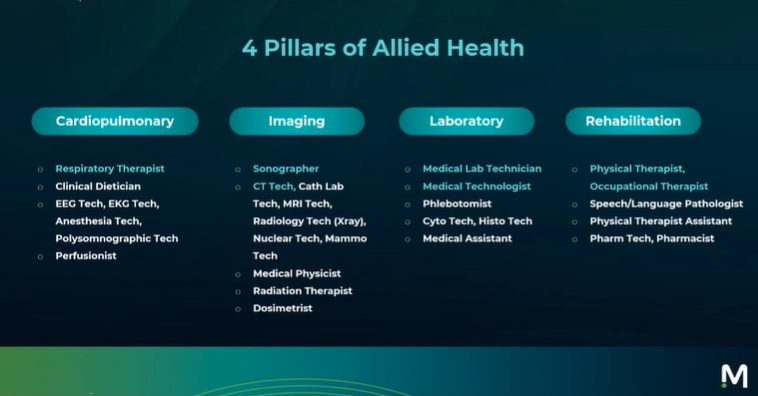
- Cardiopulmonary: This division focuses on the assessment, treatment, and monitoring of heart and lung function, often supporting patients with chronic conditions, acute respiratory needs, or cardiovascular diagnostics. “Cardiopulmonary services are critical,” Matt Neal explains, “especially with the increasing focus on non-invasive procedures that require expert respiratory care.” Specialties within the cardiopulmonary pillar typically include respiratory therapists, pulmonary function technologists, EKG technicians, and other professionals, all of whom play a direct role in managing cardiopulmonary health across inpatient and outpatient settings.
- Imaging: The largest division, providing clinicians with critical visual information to guide diagnosis and treatment planning. “Imaging services are the backbone of diagnostic medicine,” Matt notes. “The demand here remains consistently high due to advancements in medical technology.” This pillar encompasses radiologic technologists, CT technologists, mammography technologists, and other professionals who require specialized training related to specific imaging modalities and equipment.
- Laboratory Services: Laboratory Services support clinical decision-making through diagnostic testing, analysis, and reporting, often operating behind the scenes but essential to nearly every patient encounter. This includes medical technologists, phlebotomists, histotechnologists, and other lab professionals. Rebecca points out, “The consolidation of lab services into central hubs has affected demand but also streamlined many processes.”
- Rehabilitation Therapy: Rehabilitation Therapy focuses on restoring function, improving mobility, and enhancing quality of life for patients recovering from injury, illness, or surgery. Allison Chen highlights, “Rehabilitation therapy has seen a steady rise in demand, particularly with the aging population requiring more post-acute care.” This includes physical therapists, physical therapist assistants, occupational therapists, occupational therapy assistants, and speech-language pathologists, who support patients across various environments, including acute care, outpatient, home health, and post-acute settings.
What’s Driving Demand for Allied Professionals?
Allied Health roles are increasingly in high demand and hard to hire. Several factors are driving this increased need, largely influenced by demographic shifts, technological advancements, and changes in healthcare delivery models:
- An Aging Population: As people live longer, they require more medical care. “Increased life expectancy means more surgeries and long-term care needs,” says Allison. This is most evident in rehabilitation therapy, cardiopulmonary services, and diagnostic imaging, where older patients often require ongoing monitoring, recovery support, and specialized diagnostic tests.
- Medical Advancements: New treatments and technologies boost demand, especially in Imaging and Rehabilitation. Matt states, “Advancements in health screenings and non-invasive surgeries are particularly driving the need for skilled Imaging professionals.” Greater use of advanced imaging modalities, minimally invasive procedures, and outpatient care models has increased reliance on clinicians with highly specialized technical expertise.
- Lab Services Consolidation: Some hospitals centralize lab services, affecting demand in specific areas. Rebecca notes, “Large hospital systems are shifting to central lab hubs, which has slightly reduced demand for lab technicians in individual hospitals.” Even with consolidation, hospitals still depend on specialized lab roles to support rapid diagnostics, quality control, and regulatory compliance.
Why Are Allied Bill Rates Rising in Certain Specialties?
Supply and demand are the primary drivers of Allied bill rates. In practical terms, bill rates rise when specialized skills are scarce, licensing requirements are complex, or competition between regions intensifies; factors that disproportionately impact imaging and advanced diagnostic roles.
High demand for Imaging professionals keeps bill rates elevated, while lab services have seen more stability as demand levels normalize. “Imaging rates have decreased slightly but remain high due to persistent demand,” Matt observed. “In contrast, lab services are experiencing a return to pre-pandemic rates.”
How Do State Licensing Rules Impact Allied Workforce Availability?
State-by-state licensing requirements are one of the biggest barriers to timely allied health staffing. For instance, California’s stringent regulations can significantly lengthen time to fill, particularly for imaging and therapy roles. This is where Medical Solutions helps navigate these challenges. “Understanding and managing these licensing nuances is crucial for timely staffing,” explained Allison. “Our credentialing team excels in this area, helping streamline the process for our clients.”
Without centralized credentialing support, inconsistent state requirements can delay start dates and limit access to qualified allied clinicians.

What Staffing Strategies Work Best for Allied Health?
To manage staffing effectively, Chen, Mollak, and Neel advise these strategic approaches that consistently support allied health workforce stability and performance:
- Proactive Workforce Planning: Work closely with your account managers to forecast upcoming needs based on service-line demand, seasonal trends, and hard-to-fill allied specialties. Allison advises, “Proactive planning with your account manager can make a significant difference in managing staffing requirements.”
- Traveler-Friendly Culture: Create a clinical environment that supports traveling clinicians from day one. Rebecca emphasizes, “Creating a traveler-friendly culture is key to retaining top talent.” Clear onboarding, consistent schedules, and strong unit communication help improve clinician satisfaction and assignment completion.
- Speed to Market: Expedite your interview and hiring processes to compete for high-demand allied professionals. “Speed is crucial,” Matt stresses. “The faster you can move through the hiring process, the better your chances of securing high-demand professionals.” Shorter time-to-offer is often a deciding factor for imaging, therapy, and respiratory clinicians.
What is the Future of Allied Health?
Looking ahead, Allied Health will continue to evolve in response to demographic shifts, advancements in technology, and changes in how and where care is delivered. Its future will be defined by greater specialization, increased reliance on advanced diagnostics and therapy services, and the need for a flexible workforce.
Leaders who align staffing strategies with these shifts and invest in the right healthcare workforce solutions will be best positioned for success. “Staying ahead of trends and being adaptable will be essential,” says Allison.
To prepare for what’s next, healthcare organizations must align workforce planning with long-term service-line goals and access partners who can support evolving Allied staffing needs. To learn how Medical Solutions can help you strengthen your Allied workforce, connect with our team today.