
Updated July 2026
Simply put, a healthcare Managed Service Provider (MSP) is a workforce partner that helps you manage your contingent staffing program. Instead of coordinating with multiple staffing agencies on your own, you work with one MSP that manages vendor relationships, candidate submissions, compliance, reporting, and billing through a single point of contact.
What does that actually look like in practice? The easiest way to understand an MSP is to compare it to a more traditional contingent staffing model.
What Does Staffing Look Like Without an MSP?
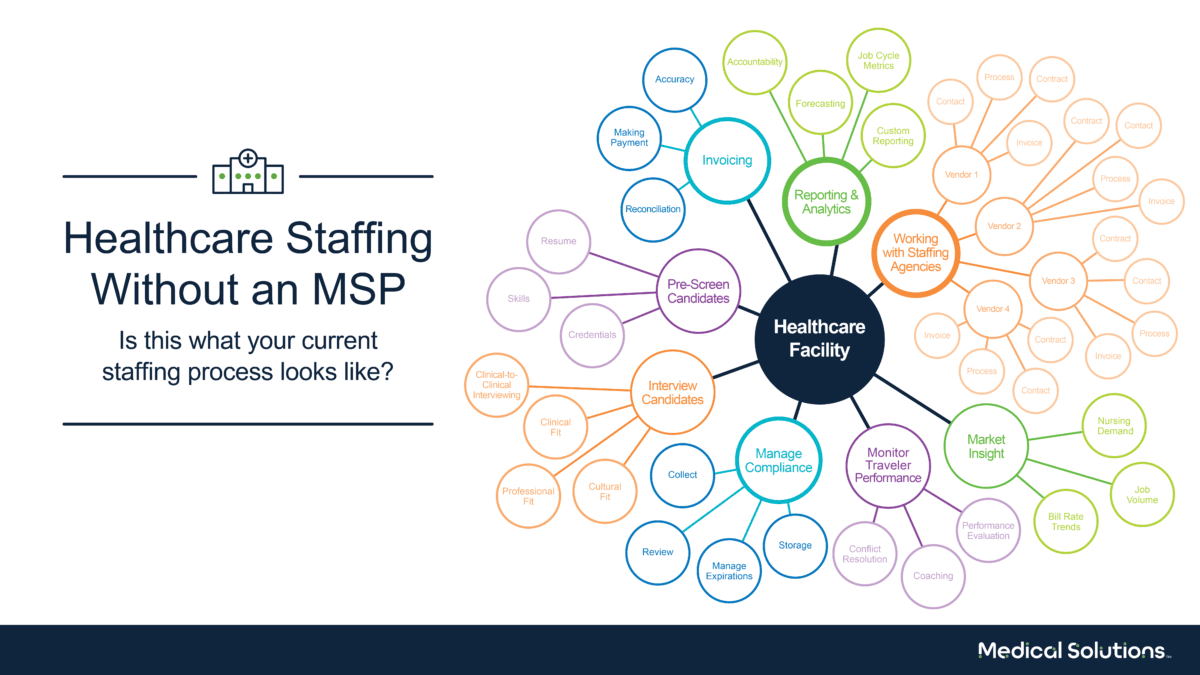
You may already work directly with one or more staffing agencies to fill temporary positions. Depending on the size and complexity of your contingent workforce program, that can mean coordinating multiple vendors, contacts, and administrative processes.
It might look something like this:
- A network of staffing agencies and vendors working independently, supporting different needs
- Different contacts for recruiting, compliance, reporting, and billing
- Separate contracts and invoices from every vendor
- More administrative work for HR, hiring managers, finance, and supply chain teams who are left managing multiple relationships, contracts, and invoices
How Does a Healthcare MSP Work?
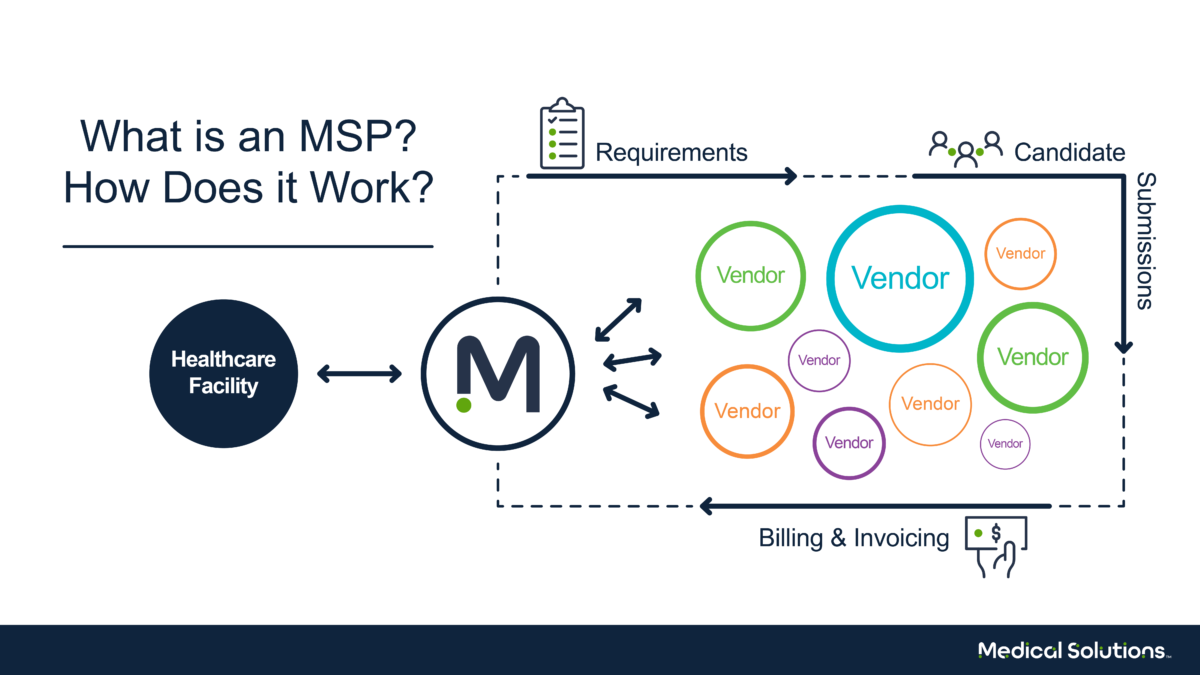
Instead of your team managing multiple vendor relationships, you work with one dedicated partner that oversees your contingent staffing program while leveraging a broad network of staffing agencies.
Here’s what that typically looks like:
- You share your staffing needs with your MSP through a single point of contact
- Your MSP distributes your openings across its network of staffing agencies and staffing partners
- Qualified clinicians are sourced and submitted for your open positions
- Your MSP coordinates the process, including vendor communication, candidate submissions, compliance, and performance
- You receive one streamlined experience, with consolidated reporting, billing, invoicing, and ongoing program support
Because MSP staffing solutions connect you with a broad network of staffing partners, your openings can reach more qualified clinicians without requiring your team to manage every vendor relationship individually.
The result is one point of contact, one contract, one invoice, and more time for your team to focus on caring for your workforce instead of coordinating it.
What Are the Benefits of a Healthcare MSP?
If you’re managing a large or complex contingent workforce program, an MSP can help simplify day-to-day operations while giving you greater visibility into your staffing strategy.
- Less administrative work with consolidated contracts, billing, and invoicing
- Expanded access to talent, getting more open positions in front of a vast database of qualified clinicians
- Greater workforce visibility, with centralized reporting and workforce insights
- More time for workforce planning, patient care, and operational goals
If you’re curious how much time goes into managing your contingent workforce today, use our Staffing Efficiency Scorecard to estimate the hours your team spends each week on activities like communicating with agencies, compliance, invoicing, reporting, and vendor management.
Common Questions about Healthcare MSPs
Q: Is an MSP only for large health systems?
A: Not always. While MSPs are often used by larger healthcare organizations with complex staffing programs, they can also benefit organizations looking to centralize vendor management and gain greater visibility into their contingent workforce.
Q: Are all MSPs the same?
A: Not necessarily. When you’re evaluating an MSP, don’t just look at fill rates. Speed matters, but so do clinician quality, program management, and the strength of the partnership behind the program.
At Medical Solutions, for example, our clinical team screens travelers for both clinical expertise and cultural fit, contributing to a 95% assignment completion rate. More importantly, we believe the right workforce strategy starts with understanding your organization rather than prescribing the same solution for everyone.
Q: What should you look for in an MSP?
A: Not all MSPs are the same. While fill rates and speed are important, they only tell part of the story. As you evaluate potential partners, also consider:
- The quality of clinicians they place
- The strength and size of their staffing network
- Their approach to vendor management and communication
- The visibility and reporting they provide
- Whether they take the time to understand your workforce goals
Is a Managed Service Provider Right for You?
If you’re working with multiple staffing partners, juggling contracts and invoices, or looking for greater visibility into your contingent workforce, an MSP may be worth exploring.
The right workforce strategy looks different for every organization. Some healthcare systems benefit from working directly with staffing partners, while others find that an MSP provides the coordination and visibility they need as their contingent workforce becomes more complex. The key is to design a model that best supports your goals, rather than forcing your organization into a one-size-fits-all approach.
Medical Solutions helps healthcare organizations build stronger workforce strategies through flexible staffing solutions, workforce expertise, and trusted partnerships. Connect with our team to learn more about our MSP staffing solutions and how we can support your workforce goals.